Everywhere I look, teams are trying to “add AI” to their UX workflow. New tools, new prompts, new experiments. And almost always the same pattern follows: excitement at first, friction shortly after. It works, technically. But it doesn’t feel smooth. Or natural. Or like the leap forward everyone hoped for.
A few months ago, I wrote an article about something I felt was missing in modern design processes. UX had become polished, structured, correct — and somehow less magical. We had frameworks for everything, best practices for every step, yet the outcomes often felt predictable. Safe. A little empty.
That article was framed around a new framework, but that wasn’t really the point. The point was that we rarely question the structures we work within. People like processes, so we stay with them, repeat them, and slowly start treating them as truths rather than choices.
What we’re doing right now is trying to fit AI into a UX workflow that hasn’t fundamentally changed in years. A workflow designed for humans, to explain a process that revolves around creativity and interpretation. For human reasoning, human limitations, human ways of making sense of the world. We take the familiar steps — research, analysis, ideation, design, validation — and try to swap parts of them with AI. As if AI should be able to do the same things we do. Just faster.
Here is where it breaks down…
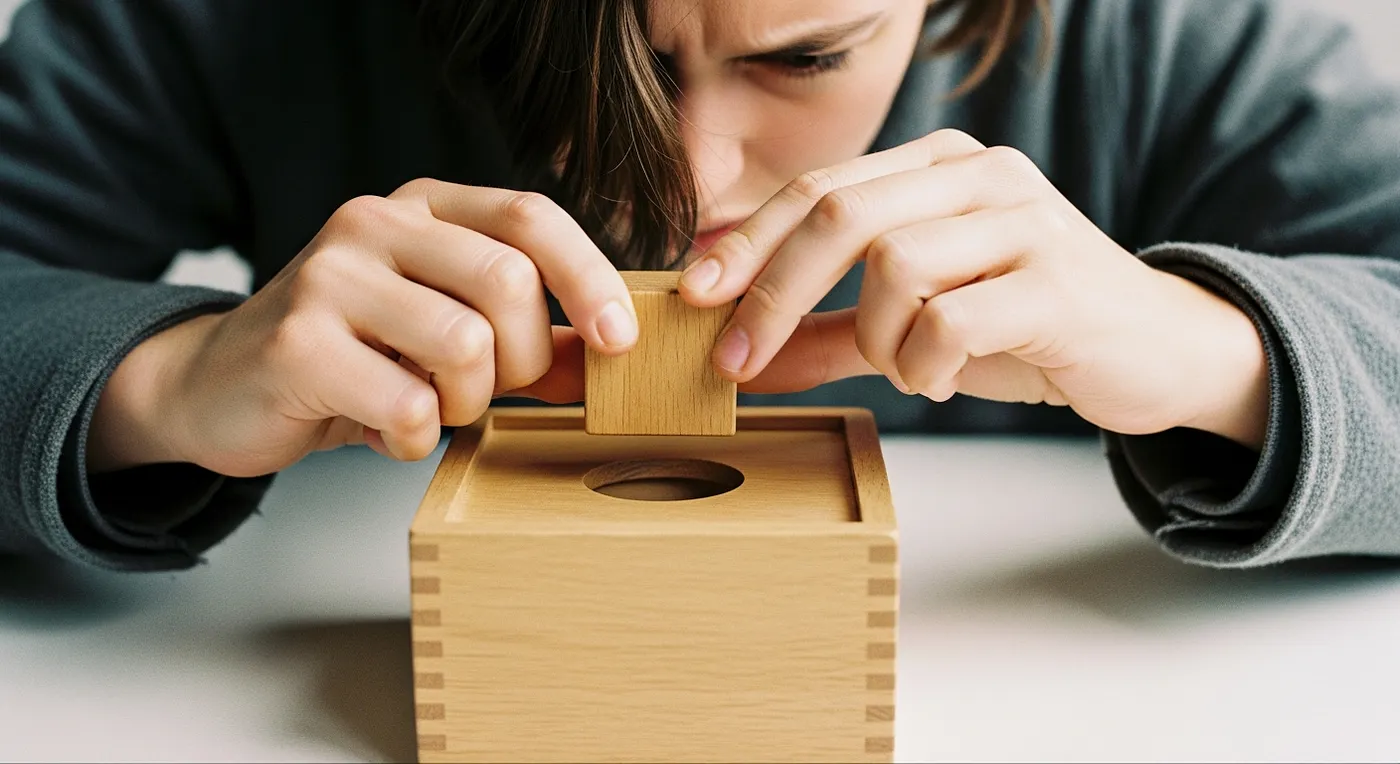
It’s an understandable assumption. But it’s also where things start to break. Because it feels like forcing a square into a circle. You can push. You can shave off edges. You can adjust expectations. But at some point you have to ask whether the problem is really the square.
What I keep noticing is that the real discomfort isn’t about AI’s output — it’s about trust. We ask AI to act like users. To evaluate flows. To suggest concepts or directions. And sometimes the results look surprisingly good.
But then the doubt creeps in.
- Why is this good?
- What is it based on?
- Would this still make sense outside this neatly worded explanation?
Not because the output is obviously wrong, but because it’s hard to tell if it’s truly meaningful or just convincing. And that’s where our expectations quietly collapse.
AI doesn’t think like we do. It doesn’t feel context (yet). It doesn’t understand consequences. It doesn’t know what’s at stake. It associates, predicts, and recombines — quickly and confidently — but without accountability or intuition. Yet we keep placing it in roles that assume exactly those qualities.
That’s what brought me back to that earlier article. In it, I argued that many design processes lead to generic outcomes not because designers lack skill, but because we operate inside rigid structures we no longer question. We follow steps because they exist, not because they still serve the work. The result is design that is technically sound, but stripped of identity, intent, and differentiation.
With AI, we’re repeating the same mistake.
We treat the UX workflow as fixed. As something neutral. Almost as a law of nature. But in reality, it’s a historical construct — shaped by constraints and expectations that no longer fully apply in this age of AI and adaptability. It was never designed for a world where ideas can be generated instantly, endlessly, and without friction.
So maybe the question isn’t where AI fits into our process but maybe the process itself needs to be reconsidered.
If we were to start today — knowing what we now know, with AI as a given rather than an add-on — would we design the same workflow? The same steps? The same expectations of what “good UX work” looks like?
We wonder whether our role as UX designers will stay or if AI makes us obsolete at one point… it probably will if we keep the definition of a UX designer the same and not evolve. I’m thinking the role of the UX designer needs to shift as well. From someone who produces, to someone who curates, evaluates, connects, and gives meaning. From maker to editor. From executor to composer. Much like that earlier framework wasn’t really about a new model, but about bringing intention, context, and identity back into design.
In that sense, AI doesn’t need to replace anything. It can exist alongside us and even strengthen our creative capabilities. Something that accelerates exploration, expands the space of possibilities, and forces us to be clearer about what actually matters.
But that requires different skills, different responsibilities, a different mindset. And a willingness to let go of some structures that once gave us certainty.
So no — the square probably won’t fit into the circle. But maybe that’s not a failure.
Maybe it’s the same invitation as before:
to redraw the shape altogether.
Also published on Medium